





X
Research source
This letter, usually 2-3 pages in length, can make or break your application. Regardless of your grade point average, work experience, test scores, or undergraduate mastery of your potential area of study, most institutions will carefully consider your Statement of Purpose when determining your candidacy for admission.
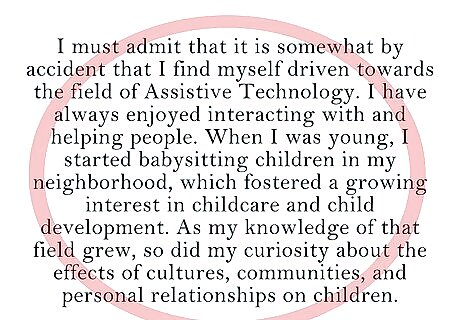
Remember that your first paragraph should be no longer than four or five sentences. However, it should also give a summary of the entire Statement of Purpose. Many graduate committees will read your first paragraph to decide if the rest of your application is worth reading as well.

Keep it clear and concise, yet detailed and specific when it comes to faculty and areas of potential research.

Don't tell the admissions committee how amazing you are. Avoid empty phrases like "I'm talented," "I'm very intelligent," "I'm a great writer/engineer/artist," or "I had the highest GPA in my department as an undergrad." Instead, show them your worth through your professional Statement of Purpose and application portfolio and let them decide if you are amazing enough to attend their institution. Should you attempt to explain how amazing you are, make sure that you justify it. Yet, you must remain humble. For example: "I believe that I have the confidence in myself to strive for the furthest goal."

Use short anecdotes to highlight your strengths. After committee members have read a few dozen, all statements start to look alike; some specific and interesting details can help a candidate stand out. Of course, it helps if these anecdotes are related to the broad point you're making in your statement.

Focus on your previous and future research experiences. Many students make the mistake of summarizing their CVs. Committees that bother to read your application know already that you're a good student; they now want to see whether you'll successfully make the transition to a more self-directed and unstructured form of learning in graduate school. They look for evidence of this in how you describe your past research experiences and your future plans. The key is not particularly the topic you propose--the committee will expect this to change after you get some more experience. Instead, they will look to see whether you have a realistic and well-informed sense of what a graduate student would expect to do to earn a degree.

Remember that a Statement of Purpose is only one, albeit extremely important, part of your graduate school admission portfolio. Carefully examine all the requirements on the university's admissions webpage before you submit an application.

Apply to as many schools as you can afford. Four distinct Statements of Purpose for four different universities should be your minimum.












Comments
0 comment