




Calculating Net Asset Value
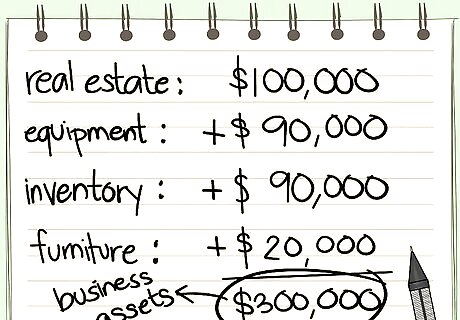
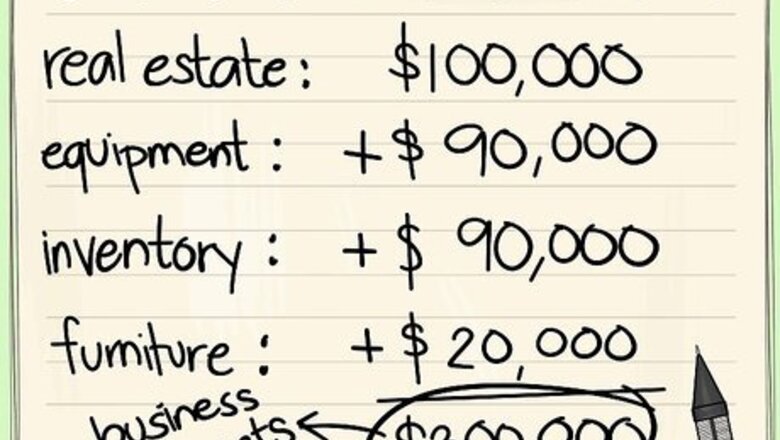
Add up the value of your business assets. These include tangible goods owned by the business. For example, office furniture, business machinery, inventory and real estate are all tangible assets. In addition, natural resource reserves and account receivables count as asset accounts. Don't worry about calculating intangible assets such as copyrights and trademarks, favorable location, community awareness, long-term contracts, and people. Unless there was capital invested (not expensed), these would never appear in the accounting records as assets.
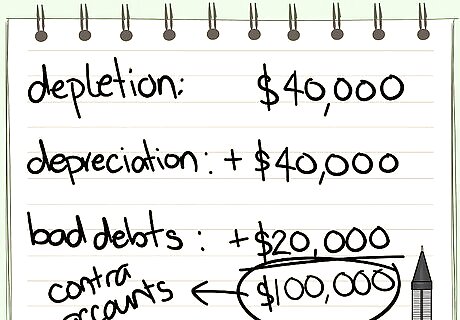
Calculate contra accounts on the businesses' assets. These include depletion, bad debts, and depreciation of the assets of the company. For example, if the machinery of a company had a certain value when purchased in 2010, let's say $100,000, it will have depreciated in value by 2015. You will need to figure out just how much the value has dropped over time. This has nothing to do with market value. For instance, if the machinery was sold it may or may not sell for the depreciated value.
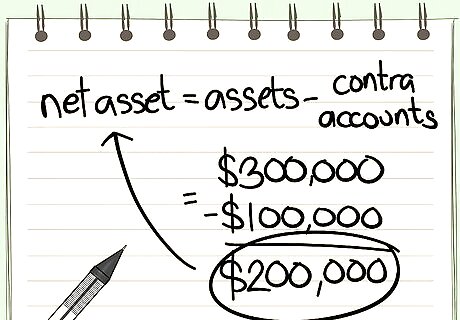
Calculate net asset value. The net asset value is calculated by subtracting the amount of your contra accounts from the sum of your business assets. For example, if you have $300,000 in assets but your contra accounts on those assets equal $100,000, then you will subtract $100,000 from $300,000, leaving you with $200,000 in net asset value.
Calculating Liability and Equity
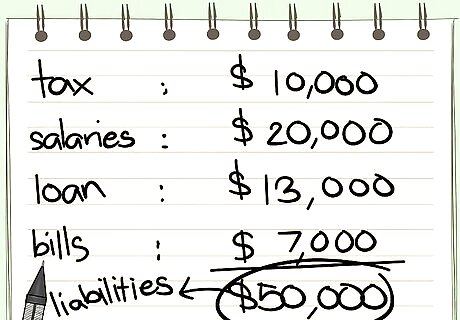
Calculate the total of your business liabilities. Liabilities are financial obligations of the company. You should bring them up to date on the day of the balance sheet. Be sure to include any interest or fees due, but not yet billed or paid (these would be expenses). Examples of liabilities include: salaries payable, interest tax payable, customer deposits, or accounts payable. You will also need to include any contra accounts in your calculations for liability. They could include bad debts, for instance. However, these are rare. The balance sheet represents a specific point in time, so assets and liabilities must be brought current on date shown on the balance sheet.
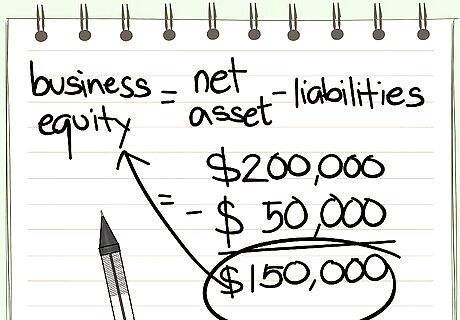
Subtract liabilities from net asset value to get the amount of equity. Specifically, subtract the total of your business liabilities from your business assets. If there’s anything left, this amount is the equity of the business or the owner’s equity. For instance, to use the previous example, if you have $200,000 in net asset value but the business owes $50,000 in loans, the equity in the business is $200,000 minus $50,000, or $150,000. Note that debt doesn't "pass on." There is either liability on the part of the owners or there is not. A corporation could have debt in its own name without any owner liability.

Calculate the equity of individual owners. Divide the total business equity by the percentage each owner owns. The resulting figures will reflect each of the owner’s equity in the business. If there are two equal owners in the business, each one’s owner’s equity would be half the total business equity.Calculate Owner’s Equity Step 6Bullet1 Version 2.jpg If there are two owners but one owns 60 percent of the company while the other owns 40 percent, the first owner’s equity would represent 60 percent of the business equity. The second owner’s equity would be the remaining 40 percent. To use the previous example, the first owner would have 60 percent of $150,000 equity, or $90,000, and the second owner would have 40 percent of $150,000 equity, or $60,000.Calculate Owner’s Equity Step 6Bullet2 Version 2.jpg








Comments
0 comment